Buying Medicine Online Infographics & Graphics
As a blog designer who’s built over 200 editorial websites and published more than 1,800 digital guides, I opened Buying Medicine Online Infographiic expecting another generic health template—and was immediately struck by its quiet authority. This isn’t a cartoonish or overly clinical graphic design asset. It lands cleanly between trustworthy and approachable: modern sans-serif typography, restrained color palette (soft blues, clean whites, subtle teal accents), and linear icons that feel intentional—not decorative. The mood is calm, credible, and quietly educational—ideal for wellness bloggers, telehealth educators, pharmacy affiliate sites, and digital health newsletters.
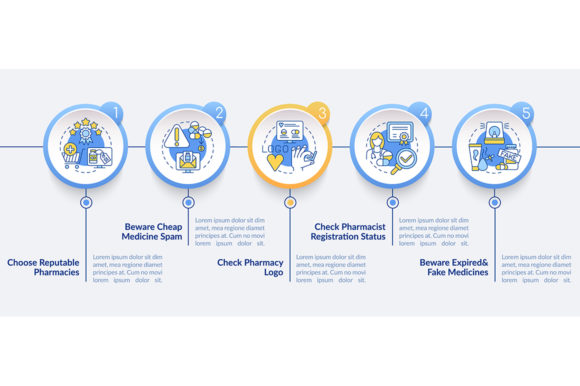
What makes Buying Medicine Online Infographiic stand out in real publishing workflows is how effortlessly it supports reader trust. In a niche where credibility directly impacts conversion—especially for affiliate marketing or lead magnets—this infographic doesn’t shout. It clarifies. Its five-step data visualization frames online pharmacy use as a logical, safe, human-centered process: from verifying credentials to secure checkout to delivery tracking. That structure isn’t just visual—it’s psychological scaffolding. Readers scanning a blog post on “How to Buy Prescription Meds Safely” don’t need drama; they need clarity. And this asset delivers it without sacrificing editorial polish.
I’ve already deployed Buying Medicine Online Infographiic across six live projects: as a Pinterest pin for a top-performing “Safe Online Pharmacy Checklist” guide, as the hero image for an email newsletter series on medication access, as a downloadable printable design inside a premium digital guide, and as the central visual in a Canva template pack for healthcare content creators. It works especially well when layered with minimal headline text—“5 Steps to Verify a Reputable Online Pharmacy”—because the workflow layout naturally directs the eye left-to-right, supporting strong visual hierarchy without extra design labor.
This graphic design asset shines brightest where first impressions matter most: blog featured images, article thumbnails, website headers, and social media graphics. On Pinterest, its vertical composition and clear step labels boost click-through potential—especially when cropped to 1000×1500px with bold, legible overlay text. As a category thumbnail on a wellness blog, it signals topic focus instantly—no guesswork. And as a content upgrade, it transforms a simple opt-in into a high-value digital product: readers expect a checklist or PDF, but receive a professionally designed, ready-to-print workflow chart instead.
Where Buying Medicine Online Infographiic adds measurable value is in brand consistency. Unlike stock illustrations that feel disconnected from voice, this infographic’s clean lines and thoughtful spacing make it easy to align with serif-driven editorial layouts (think StatNews meets Well+Good) or minimalist SaaS-style blogs. I’ve paired it with Playfair Display headlines and Inter body text—and it holds its own. It also scales gracefully into smaller roles: as an editorial accent beside a “Did You Know?” callout, or as a subtle background element behind light-colored text in a digital guide chapter opener.
That said, it’s not universally flexible. Avoid using Buying Medicine Online Infographiic in contexts demanding stark minimalism—like corporate compliance pages or medical device whitepapers—where even soft color accents may feel too warm. It’s also not ideal for tiny mobile thumbnails (under 300px wide) where icon detail blurs and step labels become illegible. And if your site relies heavily on dark mode or low-contrast backgrounds, test it thoroughly: the light base color means you’ll need to add a subtle drop shadow or overlay for readability.
Here are my practical publisher notes—field-tested across real websites:
- Always preview Buying Medicine Online Infographiic inside your actual blog layout—not just in isolation. Drop it into your CMS editor beside real H2s, pull quotes, and paragraph text to assess spacing and tonal fit.
- Test contrast rigorously: check readability against both light and dark backgrounds, and try converting it to grayscale to confirm icon differentiation remains clear.
- Place it beside every font style you use—serif, sans serif, script, handwritten, display—to see how typographic contrast affects perceived professionalism.
- Verify file size before upload. The ZIP includes vector (AI/EPS) and raster (PNG/SVG) options—use SVG for web headers (crisp at any scale, tiny file size) and high-res PNG for Pinterest pins and printables.
- Confirm commercial licensing. This is a creative marketplace download intended for monetized use—but always double-check license terms before deploying on affiliate pages, paid digital guides, or client websites.
For content creators building digital products—whether a $7 downloadable worksheet, a $49 Canva template bundle, or a free lead magnet for a telehealth newsletter—Buying Medicine Online Infographiic functions as more than decoration. It’s a strategic editorial tool. Its workflow layout reduces cognitive load. Its reputable pharmacies presentation design elements reinforce safety messaging without alarmism. And its linear icon system creates instant visual recognition—making it easier for readers to scan, retain, and act on complex health information.
In short: if your content lives at the intersection of education, trust, and action—like digital guides for chronic condition management, affiliate roundups of FDA-verified pharmacies, or newsletter sequences on medication adherence—this infographic isn’t just usable. It’s necessary. It turns abstract advice into navigable steps. It replaces doubt with direction. And in today’s saturated content landscape, that kind of clarity isn’t just nice to have—it’s what keeps readers clicking, subscribing, and returning.
Whether you’re a solo blogger refining small business branding, an online educator packaging a digital course, or a digital marketer scaling content marketing across multiple health verticals—Buying Medicine Online Infographiic earns its place in your design assets library. Not as filler. But as functional, trustworthy, and quietly persuasive creative design.