Language Study Vector Infographic: Graphics & Infographics
As a brand designer who’s built visual systems for language schools, edtech startups, and online coaches over the past 12 years, I opened Language Study Vector Infographic expecting another generic “learning” clipart pack. Instead, I found a quietly confident graphic design asset — clean but not sterile, structured but not rigid, educational without feeling academic. It landed with a calm authority: friendly enough for a lifestyle blogger’s Pinterest pin, precise enough for a digital course launch email banner, and scalable enough to anchor a full content kit.
A first impression that builds audience trust — not just attention
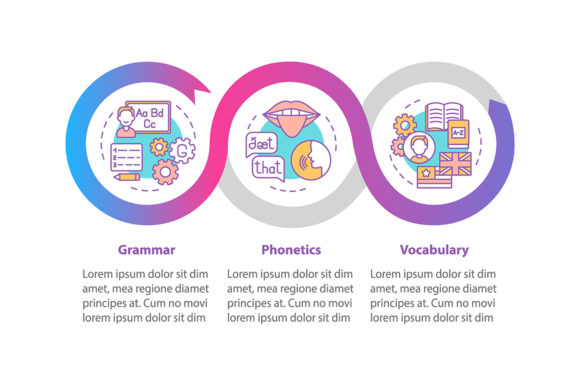
The moment you drop Language Study Vector Infographic into a mockup, it sets tone before a single word is read. Its linear workflow layout — three distinct steps rendered in balanced spacing and consistent stroke weight — signals clarity and intention. That’s critical when your audience is scanning fast: learners deciding whether to enroll, small business owners evaluating a new marketing tool, or social media managers choosing visuals for a bilingual workshop promo. It doesn’t shout; it reassures. That emotional tone — approachable professionalism — makes it ideal for premium-but-human brands: online coaches launching a grammar mastery challenge, creative entrepreneurs selling printable vocabulary trackers, or indie publishers designing editorial graphics for a language-learning newsletter.
Where this graphic design asset earns its place in real campaigns
I recently used Language Study Vector Infographic to refresh the visual backbone of a client’s summer “Fluency Jumpstart” campaign — a 3-week digital product for intermediate Spanish learners. We deployed it across six touchpoints: Instagram carousel headers (scaled cleanly as SVG), Canva templates for student-facing worksheets, a lead magnet PDF cover (paired with a warm serif font), email banners (with subtle brand-color tinting), Pinterest pins (cropped tightly to highlight the phonetics icon set), and even as a decorative border on printable flashcards. In every case, it strengthened visual hierarchy without competing with core messaging — unlike busier illustration packs that drown out text or feel dated next to modern UIs.
It performs especially well in contexts where consistency and credibility matter: blog graphics for content marketing, packaging accents for language journal kits, branded templates for course creators, and hero graphics for landing pages promoting digital products. Its modular 3-step structure also lends itself beautifully to editable Canva templates — a huge win for small business branding teams managing multiple platforms without a designer on retainer.
Marketing goals it quietly advances — no redesign required
This isn’t just decoration. Language Study Vector Infographic directly supports measurable outcomes: stronger first impressions (tested via A/B’d social thumbnails), clearer visual hierarchy (the timeline chart guides the eye naturally left-to-right), more consistent branding (its neutral-yet-purposeful aesthetic adapts seamlessly to existing palettes), and improved audience trust (its precision reads as competence, not clutter). For online coaches and product creators, that translates to higher click-throughs on digital ads, better retention in email sequences, and more memorable campaign visuals that people actually save or share.
Best-fit placements — where it shines without effort
Use it as a campaign header for language-related launches. Drop it into branded content bundles as a unifying visual thread. Apply it as a decorative brand element on website headers or digital product visuals. Feature it prominently in editorial layouts for newsletters or blogs covering linguistics, education tech, or cross-cultural communication. It works elegantly as a social media cover image (when centered and scaled), a packaging accent on printed workbooks, or a subtle background motif in presentation decks — all while maintaining professional branding standards.
Where to pause — practical limits every designer should know
Don’t force it into formal corporate branding (think law firm compliance docs or B2B SaaS whitepapers) — its warmth can clash with ultra-minimalist or high-formality contexts. Avoid dense information layouts where icons compete with data points. Skip it for small mobile graphics under 200px wide — test readability early. And never assume it’ll auto-harmonize: if your brand relies heavily on low-contrast backgrounds or monochrome palettes, verify legibility in black-and-white first. Also, avoid pairing it with overly ornate script fonts or tight-kerned display fonts — it pairs best with clean sans serifs or gentle serifs that echo its balanced rhythm.
Brand designer notes — your pre-launch checklist
Before locking in Language Study Vector Infographic for client work or paid campaigns: test it against your full brand color palette (not just primary); check how it renders in grayscale for printables or accessibility use; drop it into real campaign mockups (not just blank artboards); preview on mobile screens at 50% scale; compare spacing and balance against competitor visuals in your niche; and confirm commercial licensing — especially if distributing as part of a design bundle or digital product. Bonus pro tip: try layering it subtly behind light-weight text using 10–15% opacity for modern web design depth.
Why this creative design stands out in today’s visual noise
In a marketplace flooded with overdesigned clipart and underdeveloped SVG assets, Language Study Vector Infographic delivers restrained utility. It’s not flashy — it’s functional with feeling. Whether you’re a solopreneur building small business branding from scratch or a content marketer refreshing a decade-old resource library, this graphic design asset bridges education and aesthetics without compromise. It supports storytelling, reinforces credibility, and scales across formats — all while staying true to what good modern design should do: make complex ideas feel clear, inviting, and unmistakably human.